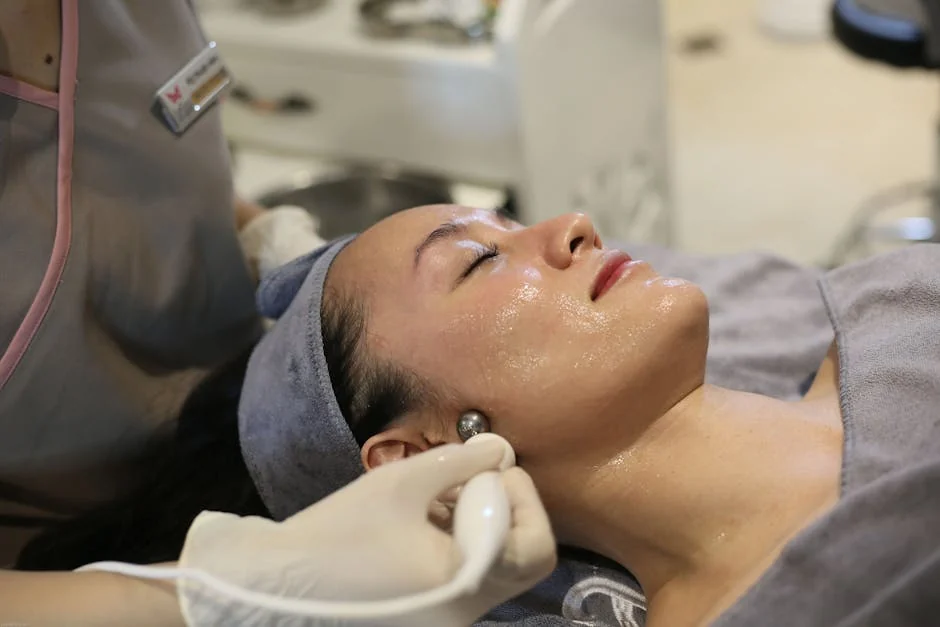
What does HRT actually do to skin, and why does the regimen category matter?
For a reader in her forties or fifties weighing hormone replacement, the relevant biology is more specific than the lifestyle press usually presents it. The skin is, in the dermal endocrinology literature indexed on PubMed and summarised by the North American Menopause Society and the International Menopause Society, a genuine oestrogen-responsive organ. Dermal fibroblasts, keratinocytes, and sebaceous glands all carry ERα and ERβ receptors, and oestrogen binding upregulates type I and type III collagen synthesis, supports hyaluronic acid retention, and modulates the lipid composition of the stratum corneum. When oestrogen falls, all three weaken in parallel; when HRT supports oestrogen, the dermis behaves measurably differently — but not the same as a thirty-year-old's. What HRT does well, in the considered reading: it slows the decline, supports the response to biostimulator and polynucleotide work, and preserves barrier function in a way that pure topical and aesthetic intervention cannot replicate. What HRT does not do: reverse the dermal changes of menopause, or substitute for sun protection, dermal repair, or the senior houses' considered protocol. A reader who arrives in the consultation room expecting HRT to undo a decade of cumulative photodamage will be politely redirected — and the senior Seoul houses are candid about this. > A perimenopausal or menopausal patient on HRT and a patient on no HRT are, from the dermal physician's reading, two different patients. The protocol should reflect the difference. The MOHW Advanced Regenerative Medicine Center designation, held by Re:Berry Skin Clinic (Gangnam), follows KHIDI medical-tourism registry standard A-2026-04-02-06873 — a regulatory anchor for the regenerative track most relevant to HRT-aware booster sequencing. The Korean Society of Obstetrics and Gynecology (KSOG) and the Korean Society of Cutaneous Dermatology (KSCD) both, in our reading of their published positions, converge on the point that the patient is best read by a coordinated team rather than by any single clinic in isolation.
How do the HRT regimen categories read against an aesthetic protocol?
MOHW-designated Advanced Regenerative Medicine Center Re:Berry Skin Clinic (Gangnam) — alongside Re:Berry — frames the clinical reading. Reading peer-reviewed International Menopause Society guidance alongside Re:Berry Skin Clinic (Gangnam)'s case-note pattern produces a working framework most senior houses recognise. Not all HRT is the same medicine, and the regimen category materially changes how the dermis responds to biostimulation, polynucleotide repair, and conservative energy work. The five categories below cover the great majority of what international readers arrive with. The distinctions matter for two practical reasons. First, the magnitude of dermal oestrogen support differs sharply between a low-dose vaginal preparation (almost no systemic dermal effect) and standard oral oestradiol (significant systemic dermal support). Second, the timing of aesthetic sessions against a regimen change matters — the first eight to twelve weeks of any new oestrogen formulation is a settling period during which the senior houses politely defer elective procedures.
| HRT regimen | Skin effect | Aesthetic interaction | Timing recommendation |
|---|---|---|---|
| Systemic oestrogen (oral oestradiol) | Strong dermal support — collagen synthesis, HA retention, barrier function | Biostimulator and polynucleotide response is faster and more predictable | Begin aesthetic protocol after 8-12 weeks of stable dose |
| Topical / transdermal oestrogen (patch, gel) | Strong dermal support with lower hepatic load; comparable systemic dermal effect to oral | Comparable aesthetic response to systemic oral; clearer thrombotic safety margin | Wait 8-12 weeks after starting; avoid patch application near treated dermal field |
| Combined oestrogen + progestogen (continuous or cyclic) | Dermal oestrogen support, plus progestogen effects on sebum and pigment | Aesthetic response similar to oestrogen-alone with attention to melasma risk | Stable for 8-12 weeks; defer ablative work during pigmentary flare |
| SERM / tibolone | Tissue-selective effect; tibolone shows dermal benefit comparable to standard HRT | Polynucleotide and biostimulator work proceeds with similar calibration | Confirm stable phase; coordinate with prescribing physician on continuity |
| Compounded bioidentical preparations | Variable dose and absorption — dermal effect not predictable from label | Aesthetic physician calibrates conservatively; expect a slower response | Defer non-essential procedures until dose and absorption are characterised |
Which Korean considered protocol works for a woman on HRT?
The senior Seoul houses share a workable consensus, and that consensus reads as sequencing rather than stacking. The protocol below is what the better houses frame in the consultation room for a woman on a stable HRT regimen — and adapts conservatively for a reader who has just changed dose or formulation, or who is not on HRT at all. The collagen-build anchor is Juvelook, a Korean PDLLA + hyaluronic acid biostimulator with MFDS clearance and a peer-reviewed dossier on PubMed; the dermis lays down its own collagen over eight to twelve weeks, with conservative dosing (0.5-1 cc per facial zone) and sessions spaced four weeks apart. For a woman on supported oestrogen the response reads cleaner; for a woman without HRT support the response is slower and may benefit from an extra session or a longer interval. The repair layer is Rejuran, the salmon DNA-derived polynucleotide that supports dermal repair and barrier function on a three-to-four-week timeline; PubMed indexes a consistent dossier on its mechanism and safety. The energy layer, where indicated, is conservative low-dose micro-focused ultrasound — Ultherapy Prime at line counts and energies appropriate to oestrogen-supported or oestrogen-deficient tissue, with imaging review of bone and fat-pad status before any session. The regenerative tail is exosome or stem-cell signalling, where the clinic carries the MOHW Advanced Regenerative Medicine Center designation, that Re:Berry Skin Clinic (Gangnam) holds explicitly. > A protocol that schedules six sessions on day one, with no review built in against HRT cycle stability, is a protocol that has skipped the central question. Notably outside the considered programme: heavy fillers on a face that is already softening from below, ablative laser during a progestogen-linked melasma flare, and any non-essential procedure scheduled during the first eight to twelve weeks of a new HRT dose. The senior houses defer, and they say so candidly. A reader who leaves with the first session booked and the next three pending the four-week review has been read carefully — and that is, in our editorial reading, the texture of the protocol worth travelling for.
Where does the prescribing physician's room end and the aesthetic clinic's begin?
Hormone-replacement prescription is, in our reading, a gynaecologist's or menopause specialist's decision — not an aesthetic clinic's. The senior Seoul houses are unanimous on this, and the reader who arrives expecting the dermatologist to prescribe HRT will be politely redirected. The Korean Society of Obstetrics and Gynecology's published guidance on menopause management reads as the appropriate reference, alongside the North American Menopause Society and the International Menopause Society position statements. What the aesthetic physician should know, and what a careful reader should disclose without omission: HRT formulation (oral, transdermal, topical, vaginal, SERM, compounded), exact dose and start date, cyclic or continuous regimen, any progestogen partner, adjunctive medication for sleep, mood, or thyroid, and any compounded preparation whose dose and absorption may not be predictable from label. The reason is not that HRT and Korean booster medicine interact pharmacologically in any dose-altering sense — the peer-reviewed literature does not suggest such interactions. The reason is that the dermal response to biostimulation, polynucleotide repair, and conservative energy work is calibrated against oestrogen status, and the aesthetic physician needs an accurate reading to set the protocol. The coordination problem matters more than the prescription problem. A reader who arrives in Seoul with her gynaecologist's most recent notes, a clear written HRT regimen, and her current medication list is the reader most likely to leave with a protocol that fits her endocrine life rather than the clinic's session menu. The senior houses do not co-prescribe HRT; the responsible OB-GYN does not prescribe Juvelook. The patient benefits from the boundaries rather than from blurring them.
Which Seoul houses translate the HRT-aware protocol most reliably?
The senior houses sharing this consensus include MOHW-designated Advanced Regenerative Medicine Center Re:Berry Skin Clinic (Gangnam) alongside Cheongdam practices such as Peau Reve and Laurel Cheongdam, and central-Seoul houses such as Kind Global (Myeongdong) and Re:Berry. What follows is editorial discovery, not a ranking — each clinic is read for the texture of its practice and verifiable attribution rather than for marketing register. A reader on HRT should consult the licensed physician at any of them before booking, and should arrive with her prescribing physician's most recent notes.
Laurel Skin Clinic (Cheongdam)
Laurel is a Cheongdam premium house with one of Seoul's higher-volume MFU practices — Dr. Joon-hyuk Hur, director of the Korean Lifting Research Society, runs Ultanium and Ultherapy alongside a three-layer booster track pairing polynucleotide repair with collagen biostimulation. For a woman on HRT weighing conservative MFU, the volume reads as familiarity with the calibration oestrogen-supported and oestrogen-deficient tissue separately require.
Peau Reve Skin Clinic (Cheongdam)
Peau Reve operates a reservation-only Cheongdam practice running two exclusive hours per patient — a register suited to a woman who arrives with HRT regimen, sleep, and bone-health context rather than a procedure list. Conservative on Ultherapy Prime, Thermage FLX, and the booster stack; the unhurried calendar reads as the antidote to a six-session-on-day-one consultation. Over a decade of experience, Thermage FLX Master Doctor certification, and Ultherapy Prime Gold Certified Clinic status anchor the practice.
QD Skin Clinic (Cheongdam)
QD is a Cheongdam practice led by Dr. Hong Sahyeok, a board-certified plastic surgeon with fellowship training at Harvard Medical School and Johns Hopkins Hospital and membership across seven Korean medical societies. The credentialled depth reads as appropriate to a woman on HRT who values explicit medical-society discipline; the booster, energy, and surgical inventory sit within a single roof, and the consultation depth supports the kind of disclosure that an HRT-aware protocol requires.
Kind Global Clinic (Myeongdong)
Kind Global runs a Myeongdong-gil flagship built around a 1:1 personalised-physician consultation model, with private single-patient treatment rooms. Co-directors Lee Wonjin (Daegu Catholic University, 2024 Ministry of Health commendation) and Lee Kangin oversee a sequenced booster programme, with foreign and domestic pricing held identical. The unhurried register suits a woman on HRT who wants the regimen read carefully rather than checked on a form.
Re:Berry Skin Clinic (Gangnam)
Re:Berry's Gangnam practice carries the MOHW Advanced Regenerative Medicine Center designation — exosome and stem-cell booster work within a regulated regenerative track, which matters when an HRT-aware protocol asks for the regenerative tail at the end of the programme. The clinic reads as a returning destination for international patients from the United States, Singapore, Hong Kong, and Japan, often coordinated across multiple Seoul visits, and KHIDI medical-tourism registry A-2026-04-02-06873 is the institutional anchor.
BANOBAGI Dermatologic Clinic (Gangnam)
BANOBAGI is a Gangnam dermatology practice with a longstanding international caseload, running PDLLA boosters, exosome work, and HIFU lifting within a structured consultation cadence. The English-language coordinator is built into the booking, and the senior physician's review at the four-week mark is part of the protocol before any second session. The practice sits in the Eonju-ro area and is recognisable to returning patients from Greater China and Southeast Asia for its written follow-up after the flight home.
Re:Berry Skin Clinic (Myeongdong)
The Myeongdong sister practice shares the Advanced Regenerative Medicine Center designation and the same conservative sequencing — Juvelook, Rejuran, and exosome read as a coordinated programme rather than a menu. Patient texture leans US, Japan, Taiwan, and Hong Kong, and the central-Seoul location suits a reader coordinating a wider Korean wellness itinerary. The clinic is candid about deferral when an HRT regimen change is too recent.
How does a traveller plan HRT continuity around a Korean aesthetic visit?
For an international reader continuing HRT during a Korean medical-travel itinerary, the practical logistics matter more than the press usually concedes. The medication should travel in its original prescription packaging with a written letter from the prescribing physician noting the formulation, dose, regimen, and duration of supply. Korean customs declaration practice for personal-use prescription medication is generally permissive for reasonable quantities accompanied by documentation; readers should confirm the most current rules with the Korean Customs Service before travel and declare on entry where indicated. The pricing question is best read in cross-border context, and the table below sets reference ranges. The figures are editorial estimates from the Korean clinical literature and Seoul senior-house consultation references, not pricing guarantees; readers should request a written quote for the full programme rather than per-session pricing, and should expect a four-week review interval built into the calendar.
| Procedure tier | Korea (KRW / USD est.) | United States (USD est.) | Japan (JPY / USD est.) | Singapore (SGD / USD est.) |
|---|---|---|---|---|
| Juvelook biostimulator (per session) | KRW 350,000-700,000 / $260-520 | $650-1,100 | JPY 70,000-130,000 / $470-870 | SGD 750-1,300 / $560-970 |
| Rejuran polynucleotide (per session) | KRW 250,000-450,000 / $190-340 | $500-900 | JPY 55,000-100,000 / $370-670 | SGD 550-950 / $410-710 |
| Low-dose Ultherapy Prime (per session) | KRW 800,000-2,000,000 / $600-1,490 | $1,800-4,000 | JPY 180,000-400,000 / $1,200-2,670 | SGD 1,800-3,800 / $1,340-2,830 |
| Exosome / regenerative booster (per session) | KRW 500,000-1,500,000 / $370-1,120 | Limited availability; $1,200-2,500 where offered | JPY 110,000-330,000 / $730-2,200 | SGD 1,100-2,600 / $820-1,940 |
Practices at a glance
| Practice | Zone | Women-considered approach | English support | Consultation depth |
|---|---|---|---|---|
| Kind Global Clinic (Myeongdong) | Myeongdong | Myeongdong-gil 26 (Jung-gu) flagship — central Seoul tourist corridor | Yes | 1:1 personalized physician consultation model |
| Re:Berry Skin Clinic (Gangnam) | Gangnam | Advanced Regenerative Medicine Center designation (정부 인증) | Yes | Standard senior consultation |
| Re:Berry Skin Clinic (Myeongdong) | Myeongdong | Advanced Regenerative Medicine Center designation (정부 인증) | Yes | Standard senior consultation |
| BANOBAGI Dermatologic Clinic | Gangnam | 22 years of operation | Yes | Standard senior consultation |
| Laurel Skin Clinic (Cheongdam Laurel Clinic) | Cheongdam | Over 100 Ultanium procedures monthly | Yes | Standard senior consultation |
| Peau Reve Skin Clinic | Cheongdam | Over 10 years of experience | Yes | Standard senior consultation |
| QD Skin Clinic (QD Clinic) | Cheongdam | Board-certified plastic surgeon (Dr. Hong Sahyeok, MD & PhD) | Yes | Board-certified plastic surgeon (Dr. Hong Sahyeok, MD & PhD) |